
Special Report: San Carlos Real Estate Update: November ’23.
December 6, 2023

Still Lagging Behind.
Welcome to December! It's hard to believe there's only one more month until we turn over the calendar, but many people will be happy to turn that page from what has been a brutal year for the San Carlos real estate market.
As I mentioned in last month's update, barring an absolute Christmas miracle the San Carlos residential real estate market will notch its lowest overall revenue number in the past 6 years. As predicted, nothing happened in November that changed that trajectory, and nothing significant enough will happen in December to alter those results either.
Below is the total sale revenue for residential real estate in San Carlos through November 30 compared to the same time period of the past 4 years:
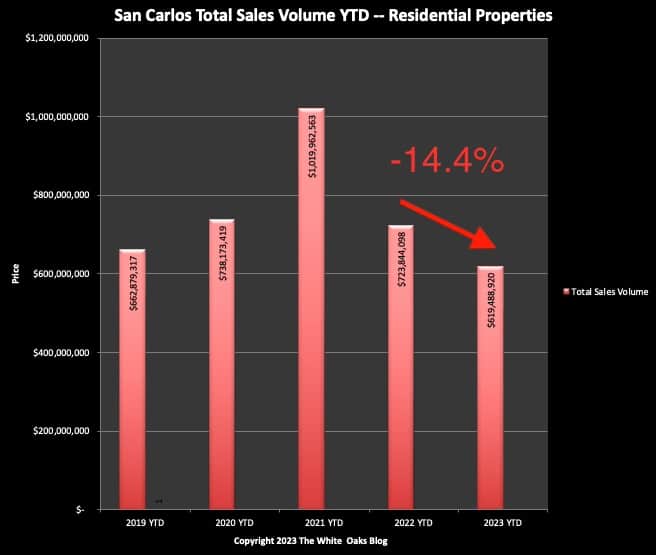
This chart shows the total revenue for all residential sales (single-family homes and condos). Not only is it running 14% below the same period in 2022, it's off by a whopping 39% from the peak of the market in 2021. That's a $400M drop in just two years.
I split the single-family home revenue numbers out from the condos below, and both charts follow the same basic trajectory as above. It also highlights the disproportionate amount of the revenue in San Carlos that is attributed to single-family homes:
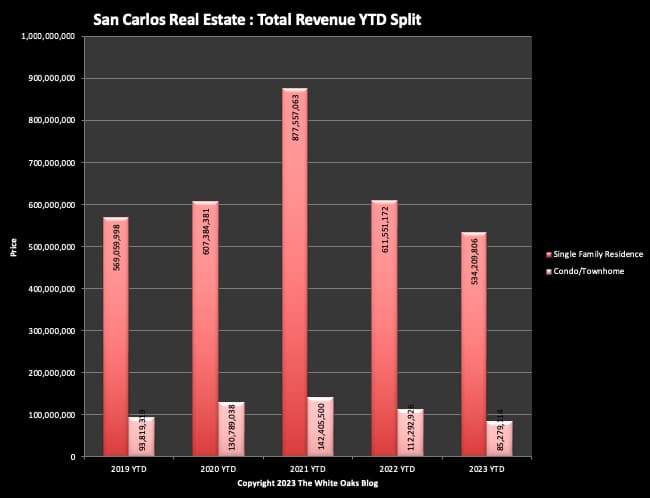
For single-family homes, this is the lowest revenue total since 2017 — for condos, it goes back to 2018. The reasons behind this drop are obvious and have been discussed at great length in this blog: High mortgage interest rates, low inventory, and economic uncertainty.
The math behind the drop also makes sense. If revenue is down, it's because either fewer units are selling or it's because the prices of those sold units have fallen. In this case, it's both:
- Unit Sales: Down 6.5% from 2022.
- Average Sales Price: Down 8.5% from 2022.
- New Listings: Down 7.7% from 2022
That final data point regarding fewer listings is worthy of discussion. First of all, I think the actual disparity is greater than 7.7% because a non-trivial number of listings were pulled off the market when they weren't selling and then re-listed in the same year, so some portion of these “new” listings may be double-counted. I think the true drop in new listings is closer to 10%.
The second reason reduced number of listings is relevant is that it highlights the reluctance of existing homeowners to sell their homes when it might mean trading their 3% mortgage for a 7% one. Obviously, those homeowners who are lucky enough to carry equity sufficient to pay for their replacement house in cash don't have that worry. But this huge disparity in mortgage rates has really put a damper on the “move-up” market.
What Lies Ahead?
Since the last Federal Reserve meeting where rates were left unchanged, there has been a swirl of speculation that the rate hikes are finally over, even though the Fed has cautioned that such a conclusion is “premature”. But that hasn't stopped the market from reacting. Interest rates have eased somewhat since the beginning of November, and the stock market just closed one of its best months of the year, which means investors are clinging to the belief that rates are headed downward finally.
If this trend continues, or even better, if the Fed decides to actually lower their prime rate, this will help ignite a rebound in the market. From everything that I've read, the Fed is not likely to consider any sort of rate reduction for at least 6 months, unless they force the economy into a deep-dive recession. But even if banks can trim 1/8 of a percent or more off the going rates, it sparks renewed interest in those home buyers that are sitting the market out right now.
And that's exactly what this market needs
Posted in: