
Coming Soon: The Electrification of Your Appliances.
January 8, 2026
Spoiler alert: The way that we heat our water and our homes is going to change.
The Bay Area Air Quality Management District (BAAQMD) has long been crusading to reduce the usage of natural gas in the nine-county district that comprises the Bay Area. While natural gas is one of the cleanest-burning fossil fuels available, its combustion still emits nitrogen oxides into the air, which the District states significantly contributes to air pollution.
Another reason to consider reducing or eliminating natural gas in residential and commercial buildings is safety. The Bay Area's gas distribution infrastructure was built many years ago, and while the utility companies are racing to upgrade critical transmission lines, the overall system is still vulnerable to a significant earthquake or even the spot failure of a high-pressure transmission line (think San Bruno).
The City of Berkeley launched the most aggressive anti-gas crusade a few years ago by forbidding ANY natural gas for newly constructed homes and buildings, but that ordinance was successfully challenged in the courts, and the full ban never went into place.
But that has not stopped the BAAQMD from pushing for a significant reduction, without eliminating gas in the home entirely. Their immediate focus is to eliminate the two largest contributors of nitrogen oxides in your home: Water heaters and furnaces.
While gas cooktops and fireplace inserts will still be permitted in homes, the District has a plan in place to phase out the use of gas-powered water heaters and furnaces over the next few years, which will very likely impact you as a homeowner.
The first appliance in the crosshairs of the District is your water heater.
The Timing of the Phaseout.
According to Rules 9-4 and 9-6 set forth by the BAAQMD, homeowners will no longer be able to install a gas-fueled water heater after January 1, 2027, which is only a year away. The phaseout for gas-fueled furnaces is January 1, 2029.
It's very important to understand that this does not mean that everyone needs to rush out and replace their gas heater with an electric unit by the deadline. Units that are already in place, or installed in 2026 before the deadline, are allowed to remain. The change takes effect if you're building a new home or if your old water heater fails after the deadline. The same grandfather clause applies to furnaces, too.
Several considerations come into play when switching from a gas heater to an electric unit, and these can vary significantly depending on the size and age of the house. Here are some of the key ones:
- Unit Cost: From the research that I've done, the unit cost of a standard electric water heater is about the same as that of an equivalent gas heater, although you have to believe that costs will come down as the volume of units increases. If you opt for a much higher-efficiency electric heat pump, they are currently about two times the price of your current gas heater.
- Installation: In order to swap a gas unit with an electric one, the existing gas line has to be capped, and the new unit has to have the proper electrical service to power it, which is most likely a dedicated 220V circuit to satisfy the power draw.
- Usage Cost: In most areas, the electricity required to power an electric heater is slightly more expensive than the natural gas that is consumed by a gas water heater.
- Reliability: According to online sources, electric water heaters are forecasted to last about 25% longer than their gas counterpart.
For newer homes, or ones that have had their electrical panels and wiring updated, the conversion to an electric water heater is straightforward — assuming there's enough space and electrical capacity in the panel.
But many homes, particularly in White Oaks and Howard Park, are electrically vintage, for lack of a better term. I've seen a fair number of homes that still use glass fuses for breakers, and have a manual-pull for the main shutoff, like this beast below:
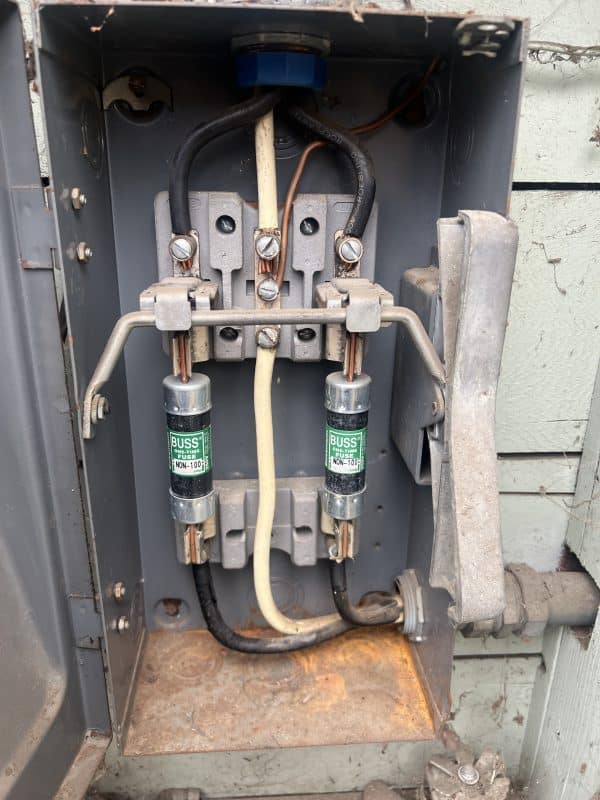
For many of these older homes, the conversion may not end up being trivial, especially if the home has less than 100A of service. If an entirely new electrical panel is required, you're looking at ~ $10K-$15K of just prep work before you can even install the new electric heater. That's a significant burden for retired homeowners and those on fixed incomes.
An Alternate Approach
If you foresee that upgrading your water heater is too problematic and costly, or if you're just simply in love with the idea of having a gas heater, there is another option — just proactively replace your gas water heater with another one before the end of the year. Since the average lifespan of a gas heater is about 15 years, you're essentially just kicking the can forward, and perhaps making it someone else's issue to solve later on.
I'll send out a reminder later this year so that if you decide to take this approach, you'll have time to line up a contractor to replace your heater before the window closes.
Posted in:
Apparently they also make heat pump water heaters that are ‘plug-in’ that just plug into a standard outlet, important if electric upgrades will be costly. Not sure about costs or reliability though, but electric costs with a heat pump will be much lower than standard electric water heaters.
I read similar issues when researching for this article. There are indeed heat pumps that operate off of the standard 110V house outlet. But if it’s anything like charging and EV, I can imagine it would take forever to heat a tank of water compared to a 220V unit.