
San Carlos Listings Have Declined for 20 Years. Here’s Why They’re Not Coming Back.
April 9, 2026
It may not be obvious to the casual observer, but the number of single-family homes that are listed every year in San Carlos is dropping – dramatically. The reason it’s not obvious is that with the advent of real estate sites on the internet, real estate apps on your phone, and the proliferation of real estate advertising, it’s easy to get the false impression that homes are for sale everywhere. There isn’t a week that goes by that I don’t hear someone saying, “Wow, there are a lot of homes on the market!”
But in reality, that’s simply not true. Today, the number of homes being put on the market, and consequently sold, is sitting at historically low levels. This is not just a recent trend, either. The graph below shows the number of new single-family homes listed over the last 20 years.
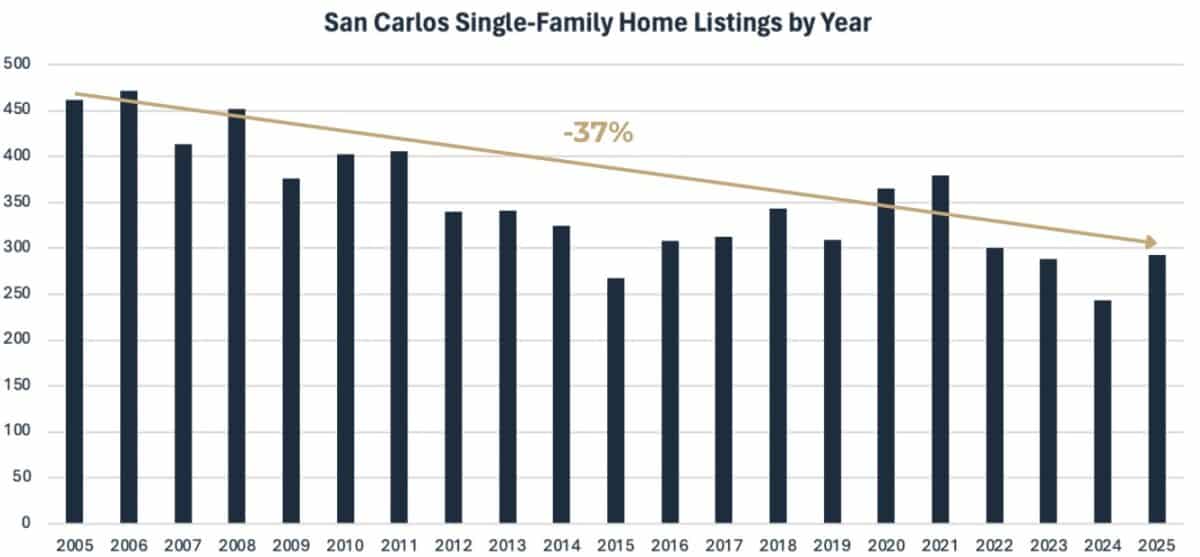
In 2005, 462 single-family homes were listed in San Carlos. 20 years later, in 2025, that number dropped to 293, or a decline of 37%. This plunge didn’t just happen overnight. As you can see from the graph, there has been a slow but steady decline over two decades. The only notable blip in this trend was the years surrounding the pandemic, which created its own superheated market surge for a couple of years.
So, why are fewer people selling their homes? The trite answer would be that San Carlos is such a wonderful place to live that nobody wants to leave. While there is certainly some truth in that statement, the real reasons are financial.
There are three of them, and they are discussed in descending order below.
#3. Home Mortgage Interest Rates (aka The Golden Handcuffs)
If there was anything good to come out of the pandemic, it was that homeowners were granted a golden gift of rock-bottom mortgage rates. The free-money policy instituted by the administration drove the average mortgage rate to historically low levels, in many cases lower than 3%. New buyers jumped on the opportunity to buy homes, and existing homeowners raced to refinance their existing mortgages.
Unfortunately, these big, beautiful mortgages are not transferable to a new property, so the thought of trading that 3% mortgage to a 6%-7% one is financially too much for some residents, regardless of how much they want to move.
Why do I have this ranked as #3 and not higher? There are a significant number of homes in San Carlos that are owned outright (i.e. no mortgage), and another big chunk where the mortgages are nearly paid off. So, while doubling the home mortgage interest rate would certainly be painful for some residents, it’s not as widespread as one might think.
#2. Property Taxes
The merits and detriments of Proposition 13 have been debated for decades, but one thing is undeniable: It has kept a very tight lid on property taxes. Here’s a perfect example from one of my recent transactions. My buyer purchased a San Carlos home from a buyer who had lived in the house for over 50 years. Her annual property tax bill? $3,300…. That’s per year, not per month. The moment that my clients closed escrow on that very same house, the property tax bill jumped to over $38,000 per year. That’s an increase of over 1,000%! And it’s payable year after year – it’s the gift that keeps on taking.
Proposition 19 allows sellers to transfer their tax basis anywhere within California, but there are restrictions – most notably, you must be 55 or older to qualify. Also, if you are buying a more expensive property, your property tax will still increase.
I believe this is a bigger impediment to moving than mortgage interest rates, because the financial impact is greater, and it impacts every homeowner, not just the ones who have a mortgage.
#1. Capital Gains Tax
In my opinion, the archaic capital gains tax law is the top reason why people who would love to put their house up for sale and move choose not to.
In a nutshell, when a homeowner sells their property, the first $250,000 of profit for a single person, or $500,000 for a married couple, is exempt from capital gains taxes. That gift was instituted by our government in 1997 – nearly 30 years ago. It has not been adjusted for inflation once since its inception.
The graph at the top of this post shows the constant decline in the number of listings from 2005 to 2025. But what did home prices do during that time frame?
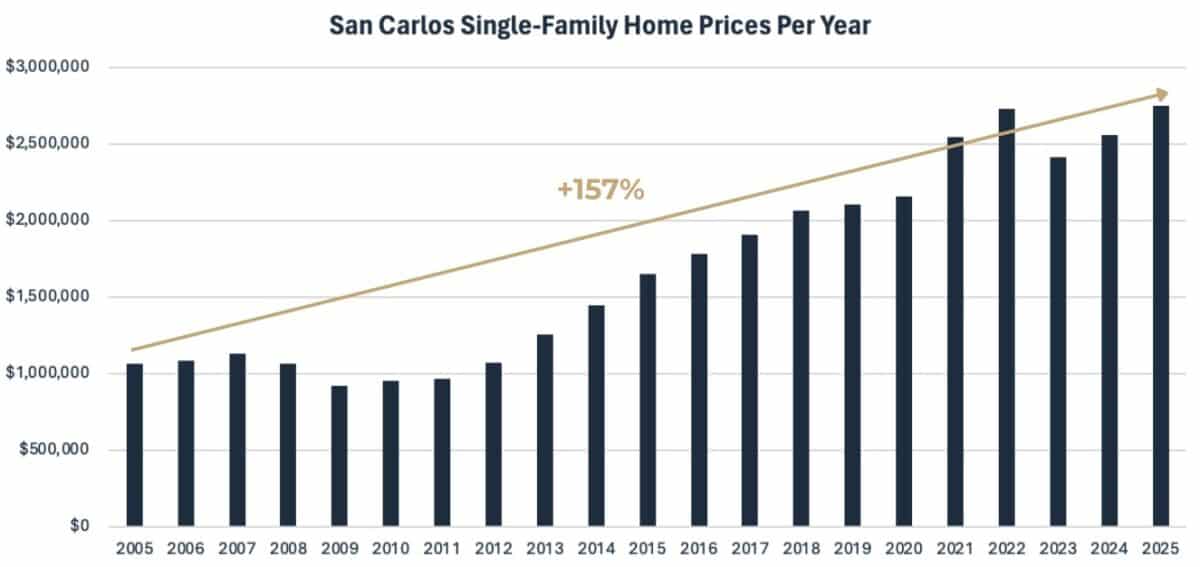
The average price of a single-family home in San Carlos grew from about $1.07M in 2005 to $2.75M in 2025. That’s an increase of nearly $1.68M, or 157%. So even after the $250,000 or $500,000 exemption is taken into account, many long-time homeowners in San Carlos are sitting on at least $1,000,000 in taxable profit when they sell their home.
Without getting lost in the weeds of the tax code, that kind of tax liability usually means cutting a large, six-figure check to the IRS and the State of California, which nobody wants to do, ever.
But, the tax law also allows for the cost basis of the home to be adjusted to the market value upon the death of the homeowner. In other words, the capital gains liability is wiped out for the heirs of the property. Armed with that knowledge, long-time homeowners are opting to either stay in their homes until their death or, if they do move out, they simply convert the home to a rental property, which keeps it in the family and avoids the dreaded capital gains tax.
These would traditionally be homes that would come up for sale, which would increase the number of listings and, consequently, more available housing in a region that desperately needs it.
The New Norm?
When these forces are coupled with the fact that there’s nowhere left in San Carlos to build a significant number of new single-family homes, I believe that this drastically reduced inventory may very well become the “new normal” in San Carlos.
Sadly, it’s hard to incentivize people to move when the financial forces that are in place make it so obviously painful.
What are your thoughts? Leave a comment bellow…
Posted in: