
Could SB 79 Change the Look of Downtown San Carlos?
August 27, 2026
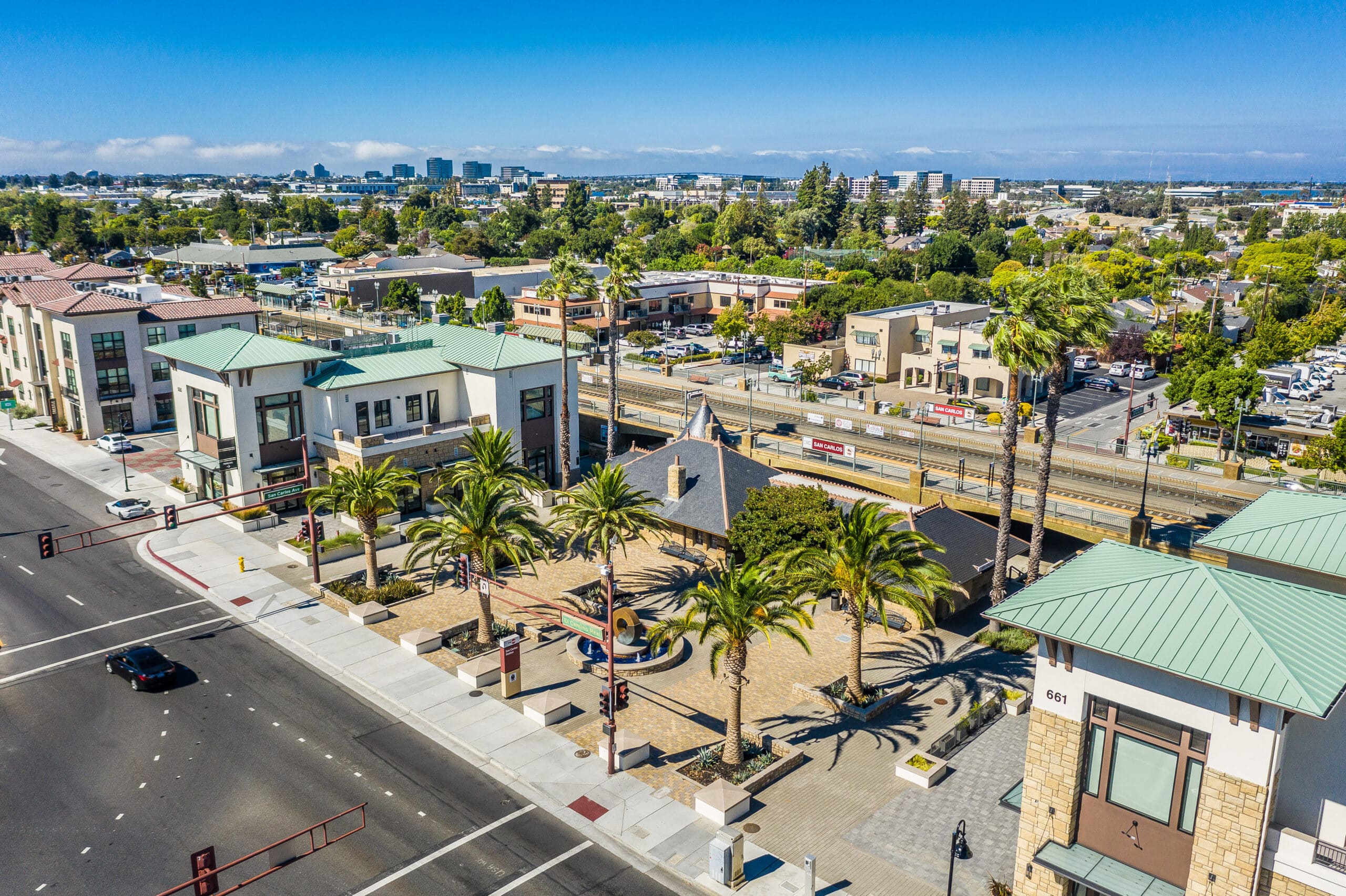
There are so many bills authored and passed by the State of California every year that it’s completely understandable if you have no idea what SB 79 is or how it may affect you. But it’s important to know what this bill means and how it may impact not only downtown San Carlos, but more importantly, the neighborhoods that border the San Carlos Caltrain station.
Senate Bill 79 was authored by Scott Weiner and was put into effect on July 1 of this year. The impetus behind the bill was to remove local barriers to adding more housing units in each city, specifically close to transit hubs, to help the State of California reach its mandated housing quota.
In a nutshell, SB 79 paves the way for the following:
- The development of multi-residential units from 5 to 9 stories high (up to 85 or 95 feet), depending on how close the site is to the transit hub, but within a quarter-mile radius of the approved transit hub.
- Overrides any local ordinance that would normally regulate such development. In other words, the impacted city has no way to block such a development.
This is, in essence, is very similar to the California law that allows for the construction of auxiliary dwelling units (ADUs) in a manner that completely overrides any restrictions that were put in place by the respective city.
At first blush, you might think, “So what? There are already lots of apartments, condos, and office buildings near the Caltrain Station in San Carlos. How is this different?” This is true, primarily because many of the parcels close to the train station and in the downtown stretch are already zoned as “multi-residential”, meaning that it’s permissible to build a multi-story living unit, provided that it conforms to the standards set forth in the City’s Municipal Code. And that’s where one of the two key differences come into play.
SB 79 can potentially allow a developer to construct a building that’s already located in a multi-residential zone that previously would not have been allowed by the City. For example, the lot size might not have been big enough to comply with the Code, or there might not be enough parking spots for the number of living units being proposed. SB79 can override those local restrictions and allow construction of a previously forbidden building, and the respective city can do very little to stop it.
The second key difference is not as obvious, but potentially far more controversial. Since SB 79 essentially erases the difference between “residential” and “multi-residential” zones, it opens the door for a multi-story building to pop up right in YOUR neighborhood, assuming you live within a quarter-mile radius of the Caltrain hub. Now, that changes things. You’re no longer protected by the residential-only restriction for building.
That’s exactly what is happening right now in, of all places, Atherton. According to this article in the Almanac, a developer was able to snag a one-acre parcel at 110 Glenwood Avenue, which, for all practical purposes, is a typical Atherton neighborhood comprised of luxury mansions set on one-acre or larger lots. But this developer is not planning on building a single-family home. Since this plot falls within a quarter-mile of the Menlo Park transit hub, they have submitted plans to replace the existing home with five separate townhouse buildings totaling 30 units, and the buildings will be nearly 45 feet high!
That’s going to go over like a lead zeppelin (rock reference intended) with Atherton residents, and lawsuits will surely start flying like hot dog wrappers on a windy day at the ballpark.
What Does This Mean for San Carlos?
Could the same thing that’s happening in Atherton happen in San Carlos? Well, in theory, yes. But practically speaking, it’s not likely. Here’s why.
If you spin the virtual compass a quarter-mile in all directions from the San Carlos transit hub, you get a distinct mix of large, already established multi-residential buildings — Wheeler Plaza, Trestle Apartments — along with a whole slew of single-family residences that sit on 5,000-square-foot lots on the Greater East Side.
That latter fact is important. In the downtown shopping area, these types of buildings have been popping up for years already, long before SB 79 was even a twinkle in Scott Weiner’s eye. Think about the former location of Headlines on Laurel Street, which is now a multistory building. Or the boutique condo buildings that have popped up at places like 977 Laurel Street, or at 560 El Camino Real. In fact, much of the immediate downtown area is exempt from SB 79 since they’ve already achieved 50% of the desired density, according to this article in the Daily Journal.
That leaves the aforementioned residential neighborhoods, especially those in the Greater East Side of San Carlos, which are comprised mostly of small, discrete parcels. To even create a concept that’s worth building, a developer would certainly need more than the typical 5,000-square-foot footprint that these homes reside on. Remember, the Atherton project is a full acre. That would involve cobbling together at least four adjacent residential properties, and I can’t see the likelihood of that many residents willingly selling out to a developer.
The areas that do pose a risk to the Greater East Side are those streets that are home to warehouses or older industrial facilities that could be prime for conversion. If that were to happen, it would only have an impact on those streets that back up directly to the industrial zones — think McCue and East San Carlos Avenue.
I’m not aware of any SB 79 applications that have hit the desk of the Planning Department in San Carlos yet, and for the residents of the Greater East Side, I hope it remains that way.
Posted in:
Thanks for the clear explanation and the potential impact (or lack thereof) of SB 79 for SC.
You’re very welcome, and thanks for your comment. I truly hope for the sake of the families within that 1/4 mile radius that nothing transpires from this. I couldn’t imagine having a 3-5 story building right next door.